Thursday, March 17, 2011

Book 8: Horseradish: Bitter Truths you can’t Avoid

Horseradish: Bitter Truths you can’t Avoid
By Lemony Snicket

Given the light of the recent global events, the book I had originally chosen to be a quick read through midterm week turned out to be more depressing than funny. So this review will be bent towards my state of mind while I was reading it and perhaps, not the best of reviews of the book itself. However, I loved the book. Perhaps you will too by the end of this post.

“The moral of this story, if you are interested, is that there are bitter truths you cannot avoid in this world.” 

I am very inclined to agree with the author. Indeed, this whole week my husband and I have been monitoring the disasters in Japan; grappling with the idea that there is a nuclear plant at the edge of meltdown, watching people separated from loved ones, people searching through wreckage for bodies and memories, hearing about freezing temperatures and blackouts and being overwhelmed by just how cruel it all is. 

And the death. 

The needless, tragic deaths of people who were, for all intents and purposes, as prepared as they could be for such an event…and who died anyways. Grandparents, children, parents, the stories of people being swept away telling the utter helplessness against a massive tidal wave. 

"What happens in a certain place can stain your feelings for that location, just as ink can stain a white sheet. You can wash it, and wash it, and still never forget what has transpired - a word which here means 'happened, and made everybody sad'."

The humanity in death. 

The grandmother found dead in her home clutching her three year old grandson, the mother who rushed her small children to safety before being swept away herself, the elderly husband who disappeared into the chaos to find his wife….it’s too much for the mind to take. It’s shocking, it’s terrible, we rail against the idea that so many who should have lived a bit longer were taken so quickly, so cruelly. 

"It is a curious thing, the death of a loved one. We all know that our time in this world is limited, and that eventually all of us will end up underneath some sheet, never to wake up. And yet it is always a surprise when it happens to someone we know. It is like walking up the stairs to your bedroom in the dark, and thinking there is one more stair than there is. Your foot falls down, through the air, and there is a sickly moment of dark surprise as you try and readjust the way you thought of things."

And the humanity in life.

The stories of the daycare reopening so children could have a sense of normality again. The ‘Fukushima 50’ who are on a suicide mission to save their people from nuclear devastation,  the people opening their homes and lives to complete strangers, sheltering them from the elements and sharing meager supplies. The village who, not waiting for rescue, began rescuing themselves; setting up water, food, shelter….community.

"It is so rare in this world to meet a trustworthy person who truly wants to help you, and finding such a person can make you feel warm and safe, even if you are in the middle of a windy valley high up in the mountains."

As Greg and I talked back and forth, back and forth trying to determine the best way to help and if it would do any good and what organization had the most impact…we came to the realization that our best efforts will not rebuild Japan. It will not bring back loved ones or houses or jobs or food or cool the nuclear plants. It will help buy blankets. Some may say that is a lot. I say it is nothing really, compared with what is unfolding. And so we sat back and realized that we will help….and it will not fix things.

"It is difficult, when faced with a situation you cannot control, to admit you can do nothing."

Our conversation shifted. It shifted to what WE would do. What we’d need to take with us if we had to evacuate, if a tornado took out our house, if water was shut off, if some event happened, were we prepared?

“It is very easy to say that the important thing is to try your best, but if you are in real trouble the most important thing is not trying your best, but getting to safety.”

We decided that we weren’t really as prepared as we could be. So we’re focusing on that. Should some natural disaster affect our lives, we’re a little more prepared, perhaps even a help to people in our community. We’re being CPR certified and will be part of a Citizens Emergency Response Team (CERT) soon. It’s not a lot, but it will fix things should they go wrong here…in a part of the world where we can directly assist. 

There aren’t words to define how terrible this disaster, among so many the past few years, is. There simply isn't a good way to communicate that dull ache that lives in your chest when shown that amount of human suffering. People just like you and me. The fact we live in a world connected by all sorts of communication methods means that, on some level, this affects everyone. Our hearts and hope are with the people of Japan as they start to move forward into a future which is vastly different from the past of a week ago. I can only hope that the following eventually rings true:

"At times the world may seem an unfriendly and sinister place, but believe that there is much more good in it than bad. All you have to do is look hard enough. and what might seem to be a series of unfortunate events may in fact be the first steps of a journey.”


If you are interested in any preparedness measures for your family, please visit the following excellent links:
INFORMATION FOR INDIVIDUALS WITH DISABILITIES

Tuesday, March 8, 2011

Book 7: Tick Tock

Tick Tock
By Michael Bennett

Attempting to introduce balance into 2011’s reading, I decided to do a quick thriller to tune out for a few days and catch up a bit on my backlog. I am so very sad that I did. This book was pathetic. Warning, I didn’t finish this book and so it hardly counts as book 7. Still, I did get halfway thru and devoted 3 days to reading it so I decided to count it anyways. It was, seriously terrible. Before reviewing the book, let me introduce you to two types of genres that I love.

The first is Mindcandy. Clive Cussler Dirk Pitt stories are an example of this type of story. The plot line is wildly unrealistic, the characters are deliciously cheesy, the villains are appropriately villainous, and the guy always gets the girl and/or good always triumphs over evil. I love it! It is as Mindcandy should be and I very much enjoy it. Just as I don’t expect a McDonald’s cheeseburger to delicately introduce me to the wonders of fine dining, but enjoy it very much nonetheless…that’s how I feel about Mindcandy books.

On the other end of that spectrum there are fabulous thrillers that are so horrifying to read and so well written that you just. can’t. put.  them. down. And night after night you lose increasing hours of sleep trying to get to the end hoping and praying that everything turns out all right. ‘Hannible’ is an excellent example of this type of book.

I like both genres, though the latter is a bit more suited to plane-rides and vacations as I can quickly become obsessed with them.

This ridiculous book fell way before the Mindcandy spectrum attempting to meet the qualifications of the ‘Fabulous Thriller’ category. The result was dismally-written dialogue with a copycat plot line and seriously brutal murder scenes that took all pleasure out of reading the rest of the book.

I draw certain lines in books. I don’t like reading about a certain variety of scenes, and top on that list are when kids get hurt/abused/killed, even if it is just fiction. The world can be cruel enough to kids without exploiting them in storylines as well. I despise books that utilize that kind of emotion to illustrate just how bad a character is. It’s ridiculous. A well-written author need not stoop to that level as a well-written book simply doesn’t need it. The scenes are tense and the reader’s vivid imagination is fully utilized. THAT is art in writing. Michael Bennett clearly doesn’t have that kind of skill. He killed off a 4-year old girl halfway thru the book, committing a cardinal sin of writing.

So I shut it down. Nope, didn’t finish the book. Don’t want to. At halfway thru, someone else would have had to take over the writing in order to finish it off in any sort of decent matter but to be honest, I just wasn’t interested enough to persevere. So don’t read this book. Avoid it and apply your time to a Crichton book you haven’t read yet or even a Cussler book you haven’t read (he cranks out 1-2 a year so you have plenty to choose from).

I’m heading back into the world of science for another book or two, reading ‘The Elegant Universe’ by Brian Greene. More to follow shortly…

Sunday, March 6, 2011

Book 6: Why We Get Fat, and What to do About it


Why We Get Fat, and What to do About it
By Gary Taubes

Continuing what is, apparently, the theme of this year, I learned a LOT in this book that I didn’t know before. I will preface this with a small insight into my life. I love food, and I’m a big fan of nutrition books, like to give them a go, and see what happens. I get really enthusiastic about menu-changes. 

But, usually it is a matter of more vegetables, or more fruit, or less processed food or, for a year, strict vegetarianism…I just love it.  

The premise of this book was very unconventional. VERY.  I’ve never been a fan of the Atkins diet (or way of eating) because it flew in the face of everything that NORMAL nutritionists tell you to do. However, this book by Taubes clearly promotes an Atkins-style of eating to promote weight loss and overall general health.
The great thing is that he actually backs his ideas up with extensive research and medical studies. Something which, up until recently, I hadn’t really thought of as missing from other nutrition books. 

Oh yeah, and no sugar. No fattening carbohydrates, and DEFINITELY no sugar. Which is a bit depressing for me as I am, admittedly, quite addicted to all things sugary. However, giving those items up (it can apparently take up to 18 months to fully quit a sugar-addiction and no longer have ‘intrusive thoughts about sweet food’) have extensive benefits. Good cholesterol goes up, bad cholesterol goes down, you drastically reduce your chances of heart-disease and even cancer and you don’t have to work out. In fact, until your body adjusts to the new food, you shouldn’t work out. Ha!

Here’s the thing. You have short term fat (essential fatty acids, or, EFAs) and long term fat storage. Short term is constantly going in and out of your fat portion of your body, keeps you from getting hungry at night…etc, and insulin regulates all this. However, carbohydrates and sugar drastically increase your insulin-levels which in turn starts the process of shuffling away short term fat into long term fat storage (these are layman’s terms. I’d highly recommend reading the book) and as time progresses you get fatter because your insulin is out of whack and fat is just going straight into long-term fat storage rather than being burned consistently. 

Reduce (or eliminate) your sugar and carbohydrate levels, and (after suffering about a week or two of withdrawl symptoms) you’ll bring your insulin levels down and start burning fat as you were meant to do.
It removes a lot of the guilt from people who are obese. 

There are plenty of studies that state that diet + exercise doesn’t work for the majority of the population, and people who are predispositioned to get fat simply can’t do much about it as your body WILL store whatever fat it feels it needs to. In fact, in a study done of a family of rats bred for weight-gain, one half of the rats were fed however much they wanted and the other half was fed an extremely restricted diet. BOTH groups gained the same amount of weight, but the rats on the food-restricted diet had shrunken internal organs from the lack of food. Rather than burn fat, their bodies simply took what it needed from vital functions. 

Obviously, this is not the case for everyone, but it does shed light into what I feel is a huge area of discrimination in our society. Obesity is not necessarily a choice, and sugar has addictive properties like that of heroin or cocaine in its dopamine-release structure. 

So, I’m cutting back based on this book and am trying to get used to coffee with JUST a bit of cream, no sugar. A big ‘meh’ so far but still better than black coffee. We’ll see how it goes, but if it ultimately helps with heart disease and cancer risks…well, it’s something I’m certainly willing to work on. We're also eating more protein now. I don't know if we'll go full-blown into the Atkins 'Induction Phase' of quick weight loss because seriously, I don't have a lot of time for that, but we are going to go mostly on a protein-based diet and see how we feel. So far, withdrawal has sucked.

Read the book. I imagine you’ll be just as surprised as I was at a number of the falsehoods the FDA, Department of Agriculture and nearly every diet book and cook book on the market attempt to teach. Still, it's interesting how ingrained (pun intended) those ideas are. I still like the food pyramid, I like the idea that if I burn 3,500 calories I will lose a pound of weight. Now I just have to keep switching my brain over to tell myself that's simply not true.


Saturday, February 19, 2011

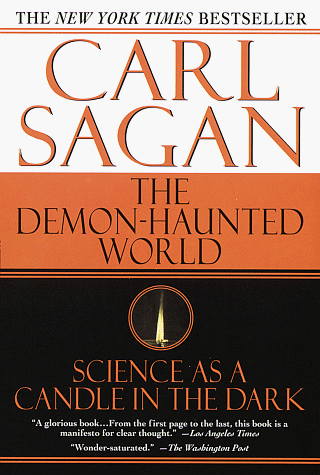
Book 5: A Demon-Haunted World


A Demon-Haunted World
By Carl Sagan

I apologize for not putting a book up last week. When I started this blog I had not foreseen becoming somewhat passionate about science and was thinking my reading would involve mostly dramatic paperbacks. Mind-candy.  It was a strange form of events, from watching a video on YouTube recommended by a friend to then reading a book referenced on the site of that video, and then finally deciding to read a book by Carl Sagan, a man who was often vilified from the pulpit of my small-town church growing up.


 But then you see pictures like this: 

That little dot on the lower right-hand side...in that band of light? That's Earth.

In 1990, at the request of Carl Sagan, NASA sent a command to the Voyager 1 spacecraft, on its way out of the Solar System, to turn its camera back towards Earth and take a picture. The above image is the result, and I get goosebumps every single time I look at it. 

I think it is very rare for a book to be life-changing, and by that I mean paradigm-changing. This blog is not to delve into my personal beliefs, so I will leave it at this book changed my paradigm, and I am so very sad that Carl died as young as he did. We need more people like him in this world lighting more candles. 

The book itself was one of the best I’ve ever read. It was entertaining and fascinating and taught much. It delved into alien abductions, religion, ghosts and the dangers of frenzied group think. A part I found particularly interesting and devastating was when he chronicled the witch hunts in Europe and America. I personally had no idea so many women and children (yes, even young girls) were killed – estimates put it as many as 2 million.

The first half of the book talked extensively about paranormal events while the second half of the book really discussed all that science had done for us as a people, how far we’ve progressed and how far we have to go. I appreciated that Carl pointed out the fact that science doesn’t eliminate the possibility of a God, I also appreciated his desire to really know, not believe, things. Carl’s enthusiasm for science is inspiring, and his style of writing is fantastic and entertaining. He quickly has topped the list as one of my all-time favorite authors. 

More than anything, the book made me think about what I want my children to know and appreciate. Geology in college taught me an enthusiasm for old rocks and dinosaurs and wildly large mammals. Now, I can add the importance of space knowledge and biology to that list. It’s the great thing about kids, you can learn right alongside them and there are so many items readily available to us like telescopes and microscopes and chemistry kits etc… ignorance does no one any service. 

One of my favorite quotes of the book was this:
“Every time we exercise self-criticism, every time we test our ideas against the outside world, we are doing science. When we are self-indulgent and uncritical, when we confuse hopes and facts, we slide into pseudoscience and superstition.”

And really, what’s more fascinating, the idea that God snapped his fingers and we popped into existence? Or the fact that ‘all the atoms that make each of us up – the iron in our blood, the calcium in our bones, the carbon in our brains – were manufactured in red giant starts thousands of light years away in space and billions of years ago in time. We are, as I like to say, starstuff’.

Thanks, Carl.

Sunday, February 6, 2011

Book 4: Surely You're Joking, Mr Feynman

Surely You’re Joking, Mr. Feynman
Richard Feynman

This book took me a bit of time to read. It wasn’t quick, and it often was clunky in the way it flowed. However, it was chock-full of fascinating information and factoids and bits of trivia about physics. I just loved it. 

Richard Feynman was about as interesting and eclectic as they come. He was a physicist who worked on the Manhattan project and won (among others) the Nobel Prize for his contributions to the development of quantum electrodynamics. This book that I read was a series of recollections and personal experiences that ultimately formed an autobiography.

 The beginning of the book was a bit difficult to get into, while I love physics (and indeed, wish I were a much smarter mathematician – I’m not well-suited to the sciences for that one fact.) he didn’t really start off with physics. The entire time he wrote about his work on The Manhattan Project, he kept talking about his fascination with picking locks, pinpointing security flaws with their security of top-secret documents, and systematically working the mail-censoring to figure out what he could and couldn’t get through the mail. Really, that whole section was just tedious. However, it showed what an interesting character he was. 

The last half of the book was much improved. It talked about his work at the universities, some information on numbers, and his insatiable desire to learn. A fun fact discovered in the book about numbers: If you divide 1 by 243 you get .004115226337 and such which is an interesting pattern. He referred to it as ‘cute’ – which probably hints at some fundamental difference in thinking which made him a physicist and me…not. The latter half of the book he became a great bongo-drum player, taught himself multiple languages, appeared to be something of a womanizer, and spent a stint in some sensory deprivation chambers where he mastered the ‘out-of-body’ experience. 

I rather liked that bit (the out-of-body experiences). He achieved a way to move his consciousness, even to the point where he had multiple out of body experiences in these sensory deprivation chambers, but came to an interesting conclusion: “The representation that things are real does not represent true reality. If you see golden globes or something, several times, and they talk to you during your hallucination, and tell you they are another intelligence, it doesn’t mean they’re another intelligence; it just means that you had this particular hallucination.” I sincerely appreciated that he know how the world worked so…completely…that he was able to brush off all personal experiences for what was known  scientifically. That is impressive to me. 

Another theme which was woven throughout the book was about second-guessing yourself. Feynman didn’t appreciate looking the part of a fool (who does?) and thus wrote often about second-guessing himself in areas where he was ultimately correct. It was interesting to read that even a world-renowned physicist dealt with that sort of self-doubt, and his ultimate message was to quit doing that already! He also talked about not taking what experts say at face-value because in his experience, experts were often wrong. He also talked about feeling socially obligated to do things. He finally gave up on that and stopped trying to live up to others expectations, realizing that he simply couldn’t and when he disappointed others, stated that individuals being disappointed in him for having high expectations really stemmed from their mistake in overestimating his ability, not his failing. I felt that was a rather interesting conclusion. Somewhat profound, really. 

The whole book was laced with that sort of general wisdom in-between his work and experiences as a scientist. He wasn’t held into a social role of “just” being a scientist or professor. He branched out into all sorts of areas that interested him. Reading that made me feel a bit more normal for the times when I extensively /obsessively start studying something (like astrophysics, nutrition, or how to make the perfect macaroon in high-altitude); it’s more an intense passion for all there is to learn in this life than anything else, and I’m glad that a new hero of mine engaged in similar activities. 

So of course I started Googling him, and found that Bill Gates published a video series of Feynman’s lectures at Cornell. FASCINATING. The internet is amazing, how else could you ever have been educated on gravitational law by a professor who is dead? It’s just incredible. Anyways, check out the videos, I highly recommend them. Project Tuva - The Messenger Series

If you're interested in science at all, I'd say this would be a great book to read. If you're not interested in science, read this anyways. It may be enough to interest you. :)

Also, a web clip I particularly enjoyed as I was watching a few other lectures and interviews with Feynman.


Sunday, January 30, 2011

Book 3: The Lost Symbol


The Lost Symbol
By Dan Brown

OK, confession. I don’t have the book I was reading for this week finished yet. What I am reading is ‘Surely you’re Joking, Mr. Feynman’ which is a pretty fantastic book. However, it is also considerably long, which is why I am only halfway through. Oh, and not only long, but full of some fairly hefty topics regarding physics and the atomic bomb. Soooo, this is going to be a book review on the last book I read before starting this blog. Dan Brown’s, ‘The Lost Symbol’. 

Yeah, yeah, mainstream book, yadda yadda, Dan Brown, yadda yadda. Stop it. I like the guy. I like the guy for the same reason I like Clive Cussler, Stephanie Myer, and James Patterson. Sometimes, all you want to do is shut your mind off and enjoy a story. The Lost Symbol is precisely such a book, however, rather than tell you all about the storyline, which you can quickly pull from your neighbor, I’ll tell you what I really liked about the book. It  is exactly what I really liked about Michael Crichton books (though, nod to Crichton, his books are way better). It was interspersed with all sorts of interesting factoids. Really fantastic factoids actually. 

For example, one of the unsolved codes in the world is called Kryptos, located at the CIA headquarters IN DC. Who knew? Oh, and what about the experiments around the turn of the century that demonstrated that the SOUL may actually have WEIGHT? Wow. What about a whole branch of science that deals with ‘fringe’ issues such as an afterlife, called Noetic Sciences?  This is great stuff. It unlocked a whole REALM of Google-searching on my phone into the wee hours of the morning. 

I can really appreciate a book that is well-researched, and then read that research squished together to make a pretty coherent storyline. Granted, in some places it felt like there was too much research packed into the story, but really, I can’t blame Dan. If I had done all that investigation, I’d want to cram as much in the book as I possibly  could. 

The storyline is great too. There’s a lot of action, mystery, suspense, plenty of daddy issues, and some interesting stuff regarding death and sensory deprivation chambers. All this is somewhat wildly interconnected. I have to really appreciate Dan’s ability to make completely unbelievable bad-guys with the worst issues imaginable highly believable. Then, what actually turned out the BE the lost symbol at the end of the book? Pretty fantastic!

It’s definitely worth a read. Is it as great as ‘The Da Vinci Code’? Probably not, but it doesn’t matter. It’s still worth borrowing from your library or friend and running through it. Especially after you’ve had some sort of a week where you need a bit of escape. 

Sorry for posting on an old topic. Next week, it’s the Feynman  book, promise. 

Sunday, January 23, 2011

Book 2: Notes from a Small Island

Book 2: Notes from a Small Island
By Bill Bryson

I had such a hard time finishing this book in the allotted week. Not because it was particularly long, or involved, but because it was such a meandering storyline I really had to force myself to keep reading. The book was…cute. The premise is fairly basic. The author, about ready to return home to the US, decided to tour England after living there for 20 years. 

So….reading the book felt like sitting in on a conversation between two people who have a lot of inside jokes. It was all about how quirky the English are, how charming they are, how they find boring things interesting and on and on and on. I’ve always wanted to visit Britain, personally, so I thought that this book would be very enjoyable…unfortunately it was just a bit tedious having never been there. Individually, the stories were entertaining; however as a whole, the book it just seemed to drag.  

I wish I had more to say. Of course I still very much want to visit Britain, there’s a portion of the book where he embarks on a walking trail that goes past monuments and roman ruins and the like and that seemed fascinating. Eventually I would very much want to do that. However I imagine it’s much more enthralling doing it than reading about it. I WAS introduced to Ordnance Survey Maps, which sound intriguing with their intense level of detail. I wish I had some for Colorado, or even just some portion of America I could drive to. I know when I visit Britain they will be one of the first things I purchase. In general, a map of his journey would have been quite helpful in picturing exactly where he was going/what he was doing.The way he talked about how much history Britain had, and how it was a non-event. People lived in houses from the 17th century, how lax the laws on protecting those houses...WOW. I think that was really the only part of the book where I kept turning pages pretty quickly (all three of them for that section).

Still, it wasn’t a bad book. It would be more one to read when I decide to travel to Britain, and that would really be one of the only cases where I would recommend it. That said, I love Bryson. His book, ‘A Short History of Nearly Everything’ is one of my all-time favorite books EVER. Read that one, not this.